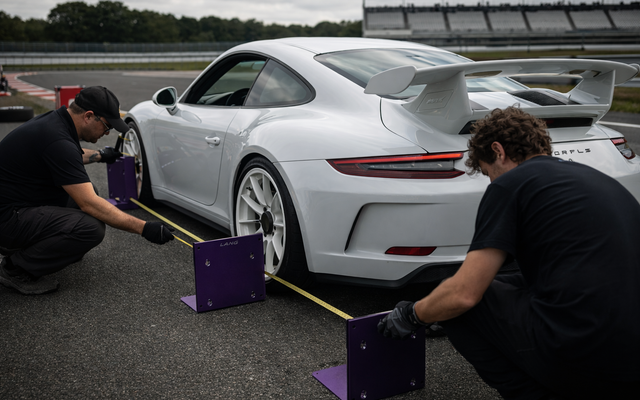
Within the high-stakes arena of today's pro-level oversteer competition, victory is far more than purely a product of brute horsepower or pilot bravado. Rather, it has evolved into a multifaceted discipline which requires a scrupulous marriage of selecting a time-tested vehicle platform, arming it with the most precise performance parts, and, most essentially, comprehending its real-time performance on the track through advanced drift telemetry software. This definitive guide will serve as your master plan starting from the initial concept of a drift build through to the last engineering-refined adjustments that elevate a capable vehicle into a consistent podium finisher. We will thoroughly explore the precise engineering of vehicle alignment optimization, illustrating how a modern vehicle dynamics tool like precise measurement hardware eradicates assumptions and delivers unparalleled insight into your vehicle's real-world behavior.
The foundation of any exceptional competitive sliding vehicle is, undoubtedly, the chassis itself. Several platforms have earned legendary standing within the worldwide oversteer culture due to their inherent weight distribution, robust design, and the immense ecosystem of specialist parts available. Picking the optimal starting point is the first and most crucial decision a builder will make. As an example, the the E36 generation BMW is universally acknowledged as one of the best overall drift platforms of all time. Its near-perfect 50/50 weight distribution, coupled with a rear-wheel-drive setup and robust six-cylinder powerplants, creates a chassis that is at once accessible for novices and extremely effective in the possession of a professional competitor. The successor of this concept, the BMW E46 platform, refines these attributes with a increasingly refined structure, increased wheel track for improved confidence, and even increased lock as standard from the factory. A different dominant option in the professional scene is the Chevrolet Corvette C6.
This American track weapon brings a unique combination of strengths to the sideways discipline, including a low-mass aluminum structure, a transaxle-style drivetrain component that aids in an excellent balance, and the immense torque of a powerful GM LS engine. This blend renders it an absolute force on track, able of initiating and sustaining continuous angles with relatively minimal application of power. For builders seeking exceptional performance per dollar, the 350Z model Nissan excels as a prime candidate. It comes from the factory with a stiff chassis, a effective factory LSD, and the free-revving V6 engine that delivers plenty of power and torque for learning and advancing in the sport. Its newer version, the Nissan Z34, brings additional refinements in chassis stiffness, handling precision, and overall powerplant output, cementing its place as a popular pick among competitive drivers. Additional legendary vehicles that warrant mention include the lightweight rotary-powered Mazda FC, the ubiquitous Nissan S13 240SX, the torque-rich SN95 generation Mustang, the more recent E90 3 Series, and the tiny yet unbelievably playful and forgiving MX-5 Miata. All of these chassis gives a different array of characteristics, complexities, and capabilities, but they all have in common the basic components required to serve as a serious drift car.
However, choosing the right car is just the first step. To unlock the full capability of every of these cars, major modifications to the steering system and chassis control systems are utterly mandatory. This is where the realm of performance tuning hardware comes into vital focus. The one most transformative upgrade for a purpose-built competition vehicle is the installation of a drift-spec steering angle kit. These sophisticated assemblies, like those manufactured by industry leaders like specialist manufacturers, are engineered to dramatically increase the chassis's possible lock-to-lock rotation. A standard street car is severely limited in how far its steering tires can rotate, a engineering trade-off for daily driving. In oversteer driving, but, extreme countersteering is continuously necessary to control and maintain a slide. An modification kit substitutes the OEM hubs, rod ends, and potentially suspension arms with components that allow the wheels to attain degrees of turn beyond 70 or even 80 degrees, as opposed to a typical stock angle of around 40 to 50 °.
This vastly greater steering angle gives the operator with exponentially enhanced command during a angle, allowing it to be much easier to initiate a drift, maintain it through a long corner, and change smoothly from one side to another. The difference in drivability is absolutely transformative. Coupled with a properly specified steering kit is the every bit as critical enhancement to the vehicle's spring and damper setup. Off-the-shelf or including premium street adjustable suspension are just not engineered for the specific and harsh requirements of drifting. A drift-spec pair of adjustable dampers is crucial. These specific suspension components feature specific damping rates and spring stiffness that are optimized for the extreme load shifting that is inherent of aggressive driving. When a driver starts a slide, the car's mass is thrown forcefully to the outer of the corner. Correct performance suspension control this shift in a predictable way, enabling the chassis to stabilize promptly and offering the operator accurate feel through the steering wheel and driver's seat. They also provide accurate setting of ground clearance, damping stiffness, and cross-weight, which are all key aspects of dialing in the car's behavior to a specific track or driving approach. As a system, a high-quality angle modification system and a correctly selected set of drift-spec coilovers are the absolute hardware base upon which all subsequent tuning is based.
Once the core components is installed, the next vital stage in the development is the meticulous tuning of the chassis's suspension geometry. This is the domain of chassis dynamics adjustment, a process that can appear intimidating to the uninitiated but is, in fact, the key to converting a set of fast pieces into a cohesive and consistent whole. The most debated element of suspension geometry for oversteer is definitely camber. Camber is the inclination of the rim compared to the upright axis when viewed from the front of the vehicle. When the top of the wheel is angled inward, this is called negative camber. For drifting, an inward tilt on the steering tires is universally employed and is considered critical. The reason is intrinsically related to physics.
When a vehicle is going around a bend at high sideways angles, the chassis rolls toward the outside of the bend. This chassis roll causes the outer front wheel to reduce its best grip area with the track surface. By introducing an inward tilt, the wheel is pre-tilted to account for this roll. As the vehicle tilts into the corner, the outside front tire gains a better contact patch against the road surface, increasing its traction at the precise moment when it is most required for control. Usually, front axle adjustments for a dedicated drift car range from approximately -3 degrees to as high as -5 degrees or even greater, based on the parameters of the vehicle setup, rubber selection, and pilot preference. The rear axle tires also utilize inward lean, but the values are usually more modest and more nuanced than the front axle. Overly aggressive inward lean at the back can result in the chassis extremely prone to oversteer and challenging to manage on power use, as it shrinks the usable grip area of the powered wheels during straight-line power delivery. Therefore, rear adjustments are frequently in the vicinity of -1 degree to -3 degrees, achieving a precise balance between giving enough side traction to help in starting and holding the slide while still maintaining effective hook-up for acceleration the corner. alignment is merely one part of the larger tuning picture, which additionally includes toe, caster, and bump steer modification.
Toe angle refers to the angle of the wheels as seen from above. Positive toe means the front edges of the wheels are nearer together than the trailing edges, while outward toe means the opposite. For sliding, a modest amount of front axle toe-out is often used to improve the initial response steering feel, making the car feel more agile and eager to start a slide. Rear axle toe is typically set to neutral or a extremely minute amount of inward toe to promote straight-line stability under throttle. self-centering is the frontwards or aft angle of the steering axis when observed from the side-on of the chassis. Increased caster improves self-centering and high-speed stability, and it additionally boosts inward lean increase during cornering, which is very advantageous. Adjusting these parameters is a detailed interplay where a adjustment to a single setting can and will impact the other settings. The conventional method for dialing in a car's alignment for drifting has long been a tedious process of trial and error. A driver or engineering group would apply a change based on intuition, drive the vehicle on track, rely on the operator's personal perception and feedback, and then introduce another tweak. This cycle would iterate over and over until the car felt "right" or the allotted testing time ran out. This system is not just exceptionally wasteful in terms of man-hours and costs, but it is additionally inherently imprecise.
Human sensation is a famously subjective data source, influenced by numerous elements such as exhaustion, car suspension tuning changing track grip levels, weather, and just the mindset of the driver on that given run. What feels "tail-happy" on one pass might feel "understeery" on the next pass, causing conflicting data and ineffective adjustments. This long-standing challenge in vehicle dynamics optimization is specifically where state-of-the-art engineering tools has stepped in to completely change the methodology.
The advent and integration of advanced vehicle dynamics tools has introduced a new age for building and optimizing professional drift machines. These tools, showcased by cutting-edge solutions like GripDial, function by directly recording the actual mechanical movement of the vehicle as it is operated on the course. As opposed to using subjective feedback, these systems acquire objective metrics on essential variables such as shock absorber movement, wheel speed, acceleration forces, wheel angle, and driver input position. This collected information flow is then processed by sophisticated applications that can visualize and analyze the data in a clear format. For the very first time, engineers and teams can observe exactly what the chassis is exhibiting at every point of a drift. This capability revolutionizes the entire suspension tuning procedure. coilover setup tips Imagine the specific task of dialing in the front negative camber for a given vehicle. Instead of applying a modification from -3 degrees to -3.5 degrees and then testing many laps to try and "feel" a difference, a suspension tuning tool can deliver immediate and definitive feedback. The application can indicate visually how the tire's grip is acting during the most important stages of a slide: turn-in, sustain, and switch. It can reveal if the current camber setting is permitting the loaded tire to maintain maximum contact or if the tire is over-stressed on its outer edge.
The tool can after analysis suggest empirical recommendations for adjustment. Perhaps the information reveals that the outside front tire is even overworking its sidewall at -3.5 degrees of negative camber, implying that an increase to negative camber, say -4 degrees, might be advantageous. On the other hand, the information might reveal that the tread is failing to coming up to temperature or that the inner edge is wearing excessively, which could suggest that there is overly aggressive negative camber and a small reduction back to -3.2 degrees would be more optimal. This standard of granularity and practical intelligence was literally unattainable in the time of pure seat-of-the-pants adjustment.
The effect of using a comprehensive suspension tuning tool extends much further than just dialing in camber. It functions as an invaluable coilover setup tips that is specific to your exact chassis. When fine-tuning the damping clickers on your coilovers, rather than using general tips or copying another driver's setup, you can use the data to see how the chassis is reacting in relation to your changes. The software can display the wheel movement data over a section of track, highlighting if the coilovers are handling the weight transfer properly or if they are allowing the car to bounce excessively after a transition. It can help in pinpointing challenges like bottoming out or excessive extension, enabling you to apply educated decisions to helper springs, rebound/compression settings, or stance. This process extends just as well to the complex art of suspension geometry optimization. Beyond camber angle, the system can offer insight into how adjustments to toe settings and caster are influencing the vehicle's stability during various phases of a drift. For example, it can allow you to ascertain the optimal car suspension tuning amount of front axle toe-out for your particular steering geometry and piloting technique by analyzing the speed of turn-in response and the stability of the vehicle at full lock. This turns the tool an exceptionally useful performance optimization handbook that is dynamically updated by the real-world performance of your own vehicle on the tarmac. It moves the entire project from a mysterious craft into a methodical optimization process.
Furthermore, the value of a platform like GripDial is not limited to experienced engineers with large funding. For the grassroots competitor, it serves as an powerful equalizer. It in essence gives the builder with the knowledge of a full-time race engineer without requiring the typical cost. It speeds up the development time by giving unambiguous directions to questions that would otherwise take seasons of trial and error to understand. A tuner can see how their specific car reacts to various settings, developing a more intuitive knowledge of suspension theory in the process. It also opens up high-level chassis dynamics techniques, permitting anyone with the desire to perfect their machine to accomplish it in a structured and successful fashion. This is notably valuable in a sport like drifting, where setup know-how has in the past been a tightly held advantage among professional drivers. In the modern era, that knowledge can be in the hands of every motivated builder.
In summary, the process to engineering and optimizing the ultimate high-performance drift car is a multi-faceted mission that perfectly combines proven mechanical wisdom with cutting-edge data tools. It starts with the strategic pick of a legendary car, then built upon the integration of critical drift-spec hardware like drift-spec angle modification systems and correctly specified competition suspension units. The build then moves into the precision stage of alignment optimization, where parameters like camber angle, toe, and caster are precisely configured to match the vehicle's new capabilities and the operator's specific needs. Finally, and what genuinely differentiates the contemporary process from the old ways, is the adoption of a sophisticated vehicle dynamics tool. This tool removes the approximation and inefficiency of solely subjective tuning by providing empirical, live information on how the chassis is actually behaving. It functions as an indispensable diagnostic aid, a comprehensive alignment optimization handbook, and a master performance analyzer. Together, this holistic approach guarantees that all component of the drift machine—from the choice of the car to the most minute click on the damper—is refined for peak competitiveness on the circuit. It embodies the total evolution of the discipline of oversteer driving, connecting physical car control with surgical chassis dynamics to build the most effective vehicles imaginable.